

Safeguard Your Credit Card: How PandaVPN Stops Online Payment Fraud
 Sharon
  2026.08.11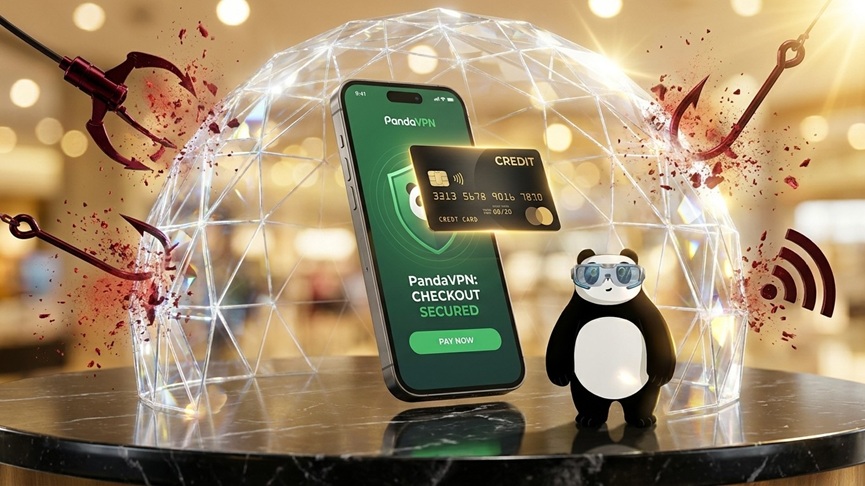
When you enter your card number, expiration date, and CVV code on an international e-commerce site, your financial data begins a vulnerable cross-border journey. From your local router to international gateway servers, any weak link can expose your wallet to hackers.
Understanding how your payment data leaks—and how PandaVPN serves as your ultimate invisible shield—is essential for safe international shopping.

1. Bulletproofing the “First Mile”: AES-256 & ECC Encryption
-
The Leak: Shopping on public Wi-Fi at cafes, hotels, or weakly secured home routers leaves you vulnerable to packet sniffing. If a smaller boutique retailer lacks proper HTTPS implementation, hackers on the same network can intercept your plain-text credit card details instantly.
-
The PandaVPN Shield: The moment your data leaves your device, PandaVPN wraps it in the highest level of secure ECC (Elliptic Curve Cryptography) encryption and AES-256 bit protocols. This creates an impenetrable tunnel. Even if a local router is compromised, attackers only see unbreakable, randomized code, ensuring absolute security right from your device.
2. Crushing Phishing Traps: Secure & Private DNS Routing
-
The Leak: One of the most dangerous cyber threats is DNS hijacking or DNS poisoning. Hackers manipulate your local Domain Name System requests to quietly redirect you away from legitimate sites (like Sephora or Amazon) to pixel-perfect clone phishing sites. Once you input your card details there, they go straight into a hacker’s database.
-
The PandaVPN Shield: PandaVPN bypasses vulnerable or manipulated local ISP servers by utilizing its own private, encrypted DNS servers. All domain queries travel through a secure tunnel, ensuring that when you type in a URL, you land strictly on the 100% authentic, official store website.
3. Beating Anti-Fraud Blocks: Ultra-Fast, Stable Global Nodes
-
The Leak: Modern payment gateways (like Stripe or Shopify) use highly sensitive fraud-detection algorithms. If your IP address constantly jumps across different global regions mid-session, anti-fraud systems flag your transaction as a “stolen card in use,” leading to declined payments or locked accounts.
-
The PandaVPN Shield: Boasting over 6,000 servers across 203 locations in 100 countries, PandaVPN utilizes patented acceleration technology and high-bandwidth IPLC (International Private Leased Circuit) lines reaching up to 10Gbps. By selecting a low-latency, dedicated, or highly stable local node, your digital footprint remains clean and consistent. This drastically reduces payment declines and ensures a smooth checkout during high-traffic flash sales.
💡 The Complete Security Truth: Beyond the VPN Tunnel
While PandaVPN ensures industry-leading transmission privacy and enforces a strict truly no-logs policy, it cannot stop server-side data breaches (such as Magecart digital skimming scripts injected directly into a merchant’s checkout backend).
To achieve 100% protection against cross-border fraud, pair PandaVPN’s advanced network encryption with these smart financial habits:
Use Tokenized Payments: Opt for PayPal, Apple Pay, or Google Pay so merchants never interact with your actual card numbers.
Deploy Virtual Credit Cards: Utilize temporary or single-use burner cards with strict spending limits via your banking app.
Toggle Remote Transaction Locks: Keep “International/Card-Not-Present” transactions toggled OFF in your banking app, enabling it only for the minutes you are actively checking out.
International online shopping should be thrilling, not anxiety-inducing. Before you head into the next global sales season, secure your digital perimeter. Fire up your PandaVPN client to lock down your network path and DNS routing, deploy a low-limit virtual card, and shop the world with total peace of mind.

Related Posts

Featured Posts